
Getting in the Corners
On 21st January 2015, around 80 delegates gathered at Hughes Hall, Cambridge, for the first ever SHARE and UCM Collections Care Conference. Ellie Ohara Anderson, UCM Intern, gives us her thoughts on the day.
Hello. My name is Ellie Ohara Anderson. I am in my final year of the MSc degree ‘Conservation for Archaeology and Museums’ at University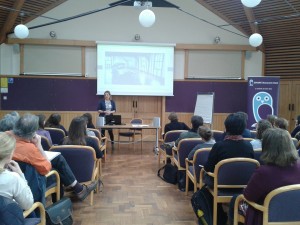 College London. Since September 2014 I have been with the University of Cambridge Museums for my 10-month conservation internship.
I am expected to experience a wide range of conservation activities during the internship and attending conferences is one of them. So, I was grateful for the opportunity to go to the first SHARE & University of Cambridge Museums Conference on Collections Care in Cambridge on 21 January 2015.
The conference opened with a warm welcome by Simon Floyd (SHARE) and Julie Dawson (Fitzwilliam Museum). Both Simon and Julie thanked Deborah Walton (University of Cambridge Museums Regional Conservation Officer) for thinking up and organising the unusual conference programme. As the title Getting in the Cornerssuggests, the day lifted the lid on collections’ issues that tend to be shelved away somewhere in the corner of museums – but which everyone knows need to be tackled!
The first speaker was Quinton Carroll (Cambridgeshire County Council Historic Environment Team). He talked about solving the problem of storing a huge quantity of archaeological material by outsourcing to a commercial storage company. While outsourcing sounds a bit radical for traditional museums, the Council’s solution is not so different from many museums’ off-site storage spaces. The key is, as Quinton said, to have a very good catalogue so that you can pinpoint and retrieve individual items without opening boxes.
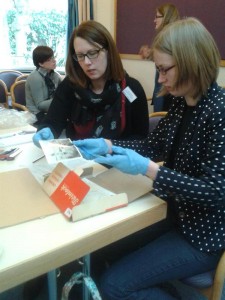 Sandra Freshney (Sedgwick Museum of Earth Sciences) told us how to approach piles of accumulated paper-based documents. She provided resource contacts for professional advice, funding, training, and record management. Her practical tips included ways to minimize physical damage to documents as well as a list of packaging materials for document storage.
Presentations shifted from archives to dealing with the museum building when it is an historical object in its own right. Jenny Mathiasson (University of Cambridge Museums) and Clare Hunt (Southend Museums Service) presented their personal experiences of how historic buildings work as display spaces. They showed how, through careful visual arrangement and sensitive placement of information, it is possible to engage visitors whilst preserving the identity and fabric of the building.
Chris Knapp (Imperial War Museum Duxford) touched on the ethical issues of conservation and curation of huge working objects, such as aeroplanes. There is no simple answer to decide what stage of an object’s history should be restored, and just how much restoration will be needed or acceptable.
The afternoon session was all about how to deal with museum objects that contain hazardous materials – from poisons to explosives!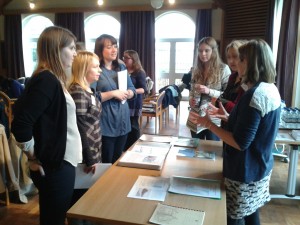
Laura Ratcliffe (freelance conservator) gave the wise advice ‘Don’t Panic’! A hazards survey is a useful tool for getting to know your collections and planning further steps. As all the afternoon speakers emphasized, the ultimate concern has to be museum workers’ and visitors’ health and safety.
Larry Carr (Science Museums Group) discussed how to maintain a collection of hazardous chemicals that have historical significance. His talk included an impressive video of the controlled burn of a dangerous chemical by experts, whilst museum staff filmed from a safe distance!
Derek Brain presented case studies showing how arsenic and asbestos, two of the most common hazardous chemicals in museum collections, are managed by Birmingham Museums Trust. Martin Adlem (independent health and safety adviser) summarized some of the legal and operational requirements for dealing with hazardous collections and the importance of proper risk assessment.
The conference closed with a Q&A session with the panel of hazards experts – an opportunity to discuss common concerns and seek advice and reassurance. The conference provided not just an occasion to learn new things, but also lots of networking among the museums.
I appreciated all the speakers who shared their knowledge and expertise through their personal experiences. I particularly enjoyed the drop-in workshop sessions held by the morning speakers where I could ask questions in a relaxed atmosphere and get some practice by taking Sandra’s ’15 Minute Archive Repacking Challenge!’.
It was clear to me that every attendee aspired to raise the quality of collections care with their colleagues within each museum and through the resources provided by the SHARE network and University of Cambridge Museums. I found it very inspiring, and I look forward to the 2nd Collections Care conference next year!
Ellie Ohara Anderson, Conservation Intern of Antiquities, University of Cambridge Museums


