
Accreditation: Millstone or Milestone?
Following on from his recent presentation to the Association for Suffolk Museums AGM, SHARE Museums East has invited Philip Wise, Heritage Manager at Colchester and Ipswich Museum Service, to share some reflections on museum Accreditation. This blog represents his personal opinion.
Recently I was delighted to be asked to present Accreditation certificates to several Suffolk museums at the AGM of the Association for Suffolk Museums. This was held at Brockford Station, the home of the Mid-Suffolk Light Railway. The ‘Middy’ as it is affectionately known is a peach of a museum. I must confess here to being an enthusiast for heritage railways; it’s in the blood I suppose as two of my ancestors were railwaymen. More significantly however the ‘Middy’ is also an Accredited museum.
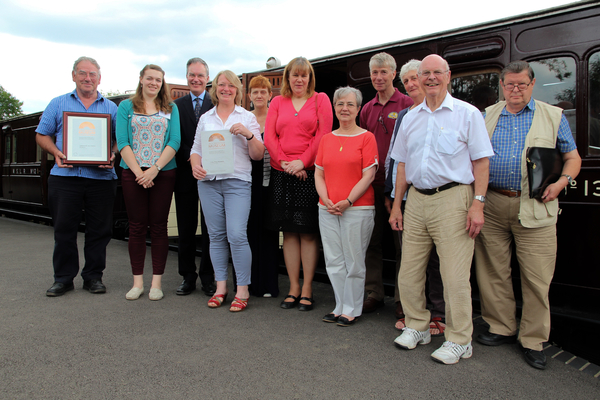
• Celebrating Accreditation achievements at the Association for Suffolk Museums AGM, Mid-Suffolk Light Railway, on 25 June 2015. Photograph by Chris Morris.
Accreditation provokes a range of reactions out there in the museum world. Some feel that Accreditation is not for them, regarding it as being a very bureaucratic process with no tangible benefits. Others recognise the importance of Accreditation as a means of raising standards and promoting the value of museums in society.
It will come as no surprise I’m sure to learn that I am firmly in the latter camp and am a passionate supporter of Accreditation. In this I can claim some knowledge as I engage with Accreditation in three ways: as a member of the Accreditation Committee which makes award decisions on applications (or returns) from museums across the UK, as a senior manager in a large local authority museum service who is responsible for ensuring that his museums remain within the Accreditation Scheme and as a Museum Mentor who encourages and supports a self-funding independent museum in achieving Accreditation.
So why Accreditation is important? Using the Arts Council’s six headings I would suggest the following:
Performance: All who manage or work in museums have a responsibility to achieve the highest possible standards that their resources of money and people will allow. There should be no exceptions and excuses.
Profile: Accreditation provides an opportunity to celebrate the achievements of your museum, boost its reputation and encourage visitors to come and see what you have to offer.
People: We should remember that museums are about people, and that those who visit or use our services are as important as those who work in museums.
Partnerships: Even at a local level and on a small scale museums can and do cooperate. In the present financial climate we can’t afford to ignore this aspect of our work.
Planning: Writing a forward plan can be a demanding activity which some will be reluctant to do and yet as with performance this should be an accepted part of running a museum.
Patronage: A funding application will always be strengthened if it comes from a museum that is Accredited.
Some have criticised the scheme for the ‘mountains of paperwork’. It is true that Accreditation does require a number of policies, plans and procedural manuals to be in place and up to date. However, it is important to remember that Arts Council has a very different level of expectation regarding a return from a national museum as compared to that from a local museum. With Accreditation size does matter!
Others have criticised what they regard as the dilatoriness of the Arts Council. The published assessment target is five months from point of application or return to the confirmation of a decision. Where it is known that this target will not be met Arts Council ensures that it maintains a dialogue with the museum concerned. Typical reasons for not meeting the target include where Assessors face particularly challenging cases or where an applicant does not provide the necessary information to complete an assessment.
Fundamentally I think that there is a real difference in the nature of an Accredited as compared with a non-Accredited museum. A non-Accredited museum may be characterised as being like a private collection where the focus is solely on the present moment and access is allowed to the public as a secondary consideration. Such museums, particularly if they contain community history items, do not fully appreciate that they have a real responsibility to present and future generations to preserve knowledge as represented by real objects. To use an old fashioned term what I am talking about here is ‘Stewardship’, which may be defined as the acceptance or assignment of responsibility to shepherd and safeguard the valuables of others. By contrast an Accredited museum fully lives up to its responsibilities to society, has a long term view and recognizes the importance of the visitor experience.
I am pleased to be able to write that Accreditation is thriving in the East of England. The latest statistics, which cover the period between November 2013 and November 2014, show that we have 161 museums in the Accreditation Scheme which represents a slight increase over the previous twelve months. Nationally we have 12.2% of Accredited museums and are in third place behind the South East (17.7%) and the South West (14.7%). With your help we could do even better in 2015 and perhaps challenge for second place.
Finally let’s return to millstones. What does a millstone do? It takes a raw ingredient, grain, and makes it into something that we can use, flour. In the same way Accreditation exists as a framework that you, and all other museum workers paid or volunteer, can use to take a collection of stuff and convert into something which benefits society. So Accreditation is a mark of success; not a millstone but a milestone.


